🌋📑 Venezuela Çift Depremi: 24 Haziran 2026 Yaracuy–Carabobo Doublet Analizi


🌍 Auto-translated · Change language above
Earthquake Doublet · June 2026
⚡ Venezuela Mw 7.2 + 7.5 — Twin Rupture
Caribbean–South American Plate Boundary · 24 June 2026, 22:04–22:05 UTC
🌎 Seismological Analysis · 24 June 2026

The 24 June 2026 Venezuela Earthquake Doublet

Two M7+ earthquakes struck 38.8 seconds apart and only 11.3 km away from each other — a rare seismic doublet at the Caribbean–South American plate boundary.

🌏 Venezuela ⚡ Mw 7.2 + 7.5 ⏱ 38.8 sec apart 📏 11.3 km separation 🔴 Doublet 📐 Bath's Law 🏙 Caracas basin effect
📅 24 June 2026 ⏱️ ~7 min read ✍️ Seismological Analysis 📡 SeismoReport v3.1

Key Finding

On 24 June 2026 at 18:04 local time, a Mw 7.2 earthquake struck Yaracuy, Venezuela. Just 38.8 seconds later, a Mw 7.5 struck 11.3 km to the southeast in Carabobo. Multi-agency moment tensor solutions show nearly identical right-lateral strike-slip beach balls for both events — the hallmark of a seismic doublet, not a classic foreshock–mainshock pair. Bath's Law magnitude gap of only ΔMw=0.3 (expected: 1.2) confirms this classification.

📍 Full SeismoReport including EMSC seismicity maps, intensity–distance curves, macroseismic testimonies and moment tensors available via the full report link below.

Mw 7.2
⚡ Foreshock — 22:04:32 UTC
Yaracuy · 10 km depth · EMSC reviewed
Mw 7.5
🔴 Mainshock — 22:05:11 UTC
Carabobo · 10 km depth · EMSC reviewed
38.8 s
Time separation (Δt)
Dynamic triggering delay ~37 s after P-wave
ΔMw 0.3
Magnitude gap (Bath's Law: 1.2)
→ Doublet · Expected largest aftershock: M6.3
🔬 Three Critical Dimensions of This Doublet
01

Doublet Classification — Bath's Law Test

Bath's Law states the largest aftershock is typically 1.2 Mw below the mainshock. Here the gap is only 0.3 Mw. Multi-agency solutions (CPPT, AUST: Mw 7.5; SC4: Mw 7.6 for the "foreshock") suggest the true magnitude difference may approach zero — the strongest possible evidence for a doublet. The two events likely ruptured adjacent segments of the same Boconó–coastal range fault system.

02

Identical Moment Tensor Mechanisms

EMSC double-couple MT solutions for both events show nearly identical beach ball geometry: dominant dextral (right-lateral) strike-slip faulting on NE–SW or E–W nodal planes — consistent with the Caribbean–South American plate boundary kinematics (~20 mm/yr eastward motion). Mechanism identity at two epicentres 11.3 km apart is the clearest seismological fingerprint of a doublet rupture.

03

Caracas Basin Amplification — Non-Monotonic Intensity Anomaly

EMSC DYFI data reveal a striking anomaly: corrected MMI intensity increases from 5.6 at Maracay (72–122 km) to 6.8 at Caracas (122–209 km) — a +1.2 unit rise despite greater distance. This Quaternary alluvial basin resonance effect (identical to 1967 Caracas M6.5 observations by Seed et al.) places 7.1 million people at disproportionate risk relative to their distance from the epicentre.

📐 Moment Tensor Solutions — Identical Mechanisms

EMSC published multi-agency double-couple MT solutions for both events. The nearly identical beach ball geometries — both showing dominant right-lateral strike-slip faulting — are the most compelling visual proof that the two ruptures share the same fault system.

Mw 7.2 Foreshock MT
Fig. 1 — Mw 7.2 Foreshock (22:04 UTC)
NEIC: 7.2 · CPPT: 7.5 · GFZ: 7.3 · AUST: 7.5 · SC4: 7.6
Dextral strike-slip · Z ≈ 12–16 km
Mw 7.5 Mainshock MT
Fig. 2 — Mw 7.5 Mainshock (22:05 UTC)
GCMT: 7.5 · GFZ: 7.4 · NEIC: 7.5
Nearly identical beach ball · Z ≈ 12–13 km
Why identical mechanisms matter In a classic foreshock–mainshock pair, the two events may involve stress transfer across different fault planes. When both events show the same focal mechanism at nearly the same depth and just 11 km apart, it strongly indicates the same fault segment or adjacent parallel segments — the defining characteristic of a doublet.
📊 EMSC Intensity–Distance Curves

EMSC "Did You Feel It?" data from 100+ witnesses across 12 countries reveal a non-standard attenuation pattern for both events, with a pronounced secondary intensity peak at Caracas despite its greater distance.
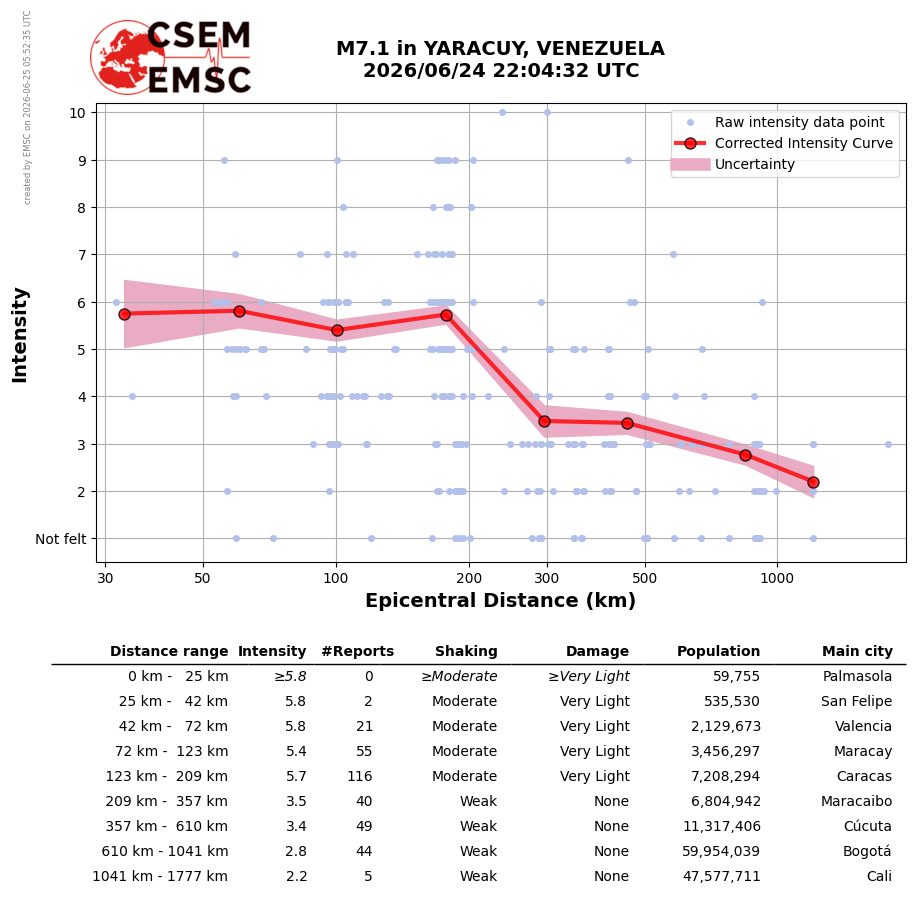
M7.2 Intensity-Distance
Fig. 3 — M7.2 Intensity–Distance
MMI 5.4–5.8 · Felt to 1,780 km (Manaus, Brazil)
Mild Caracas secondary peak (+0.4)
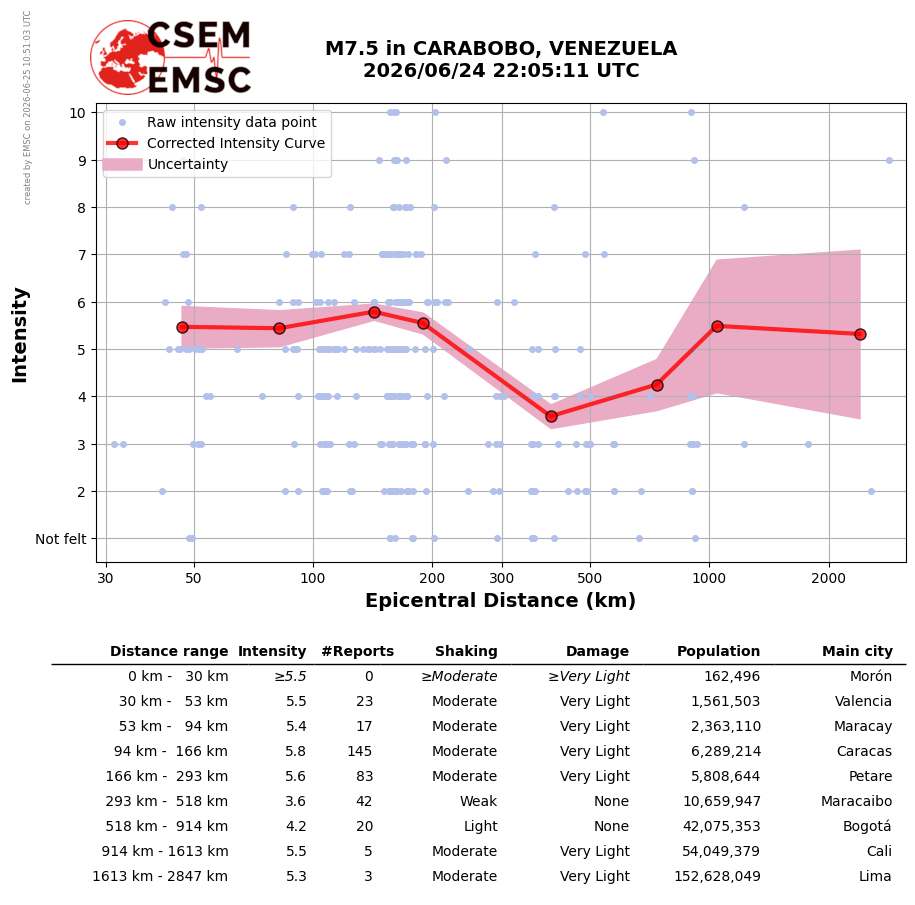
M7.5 Intensity-Distance
Fig. 4 — M7.5 Intensity–Distance
MMI ≥6.7 at Valencia (42–72 km)
Caracas: 6.8 vs. Maracay: 5.6 → +1.2 anomaly
⚠️ The Caracas Anomaly: Standard intensity attenuation predicts a monotonic decrease with distance. For the Mw 7.5, MMI actually increases from 5.6 at 97 km (Maracay) to 6.8 at 160 km (Caracas). This +1.2 unit rise reflects ~4× ground motion amplification in the Caracas Quaternary alluvial valley — the same phenomenon documented after the 1967 M6.5 Caracas earthquake (Seed et al. 1972). With 7.1 million people in this basin, it represents the highest aggregate seismic risk from this doublet.
🗺️ Background Seismicity — 66 Years of Context

EMSC background seismicity maps (ISC+EMSC catalogue, 1960–2026, N≈50,000 events M≥3) place the 2026 doublet in its long-term tectonic context.
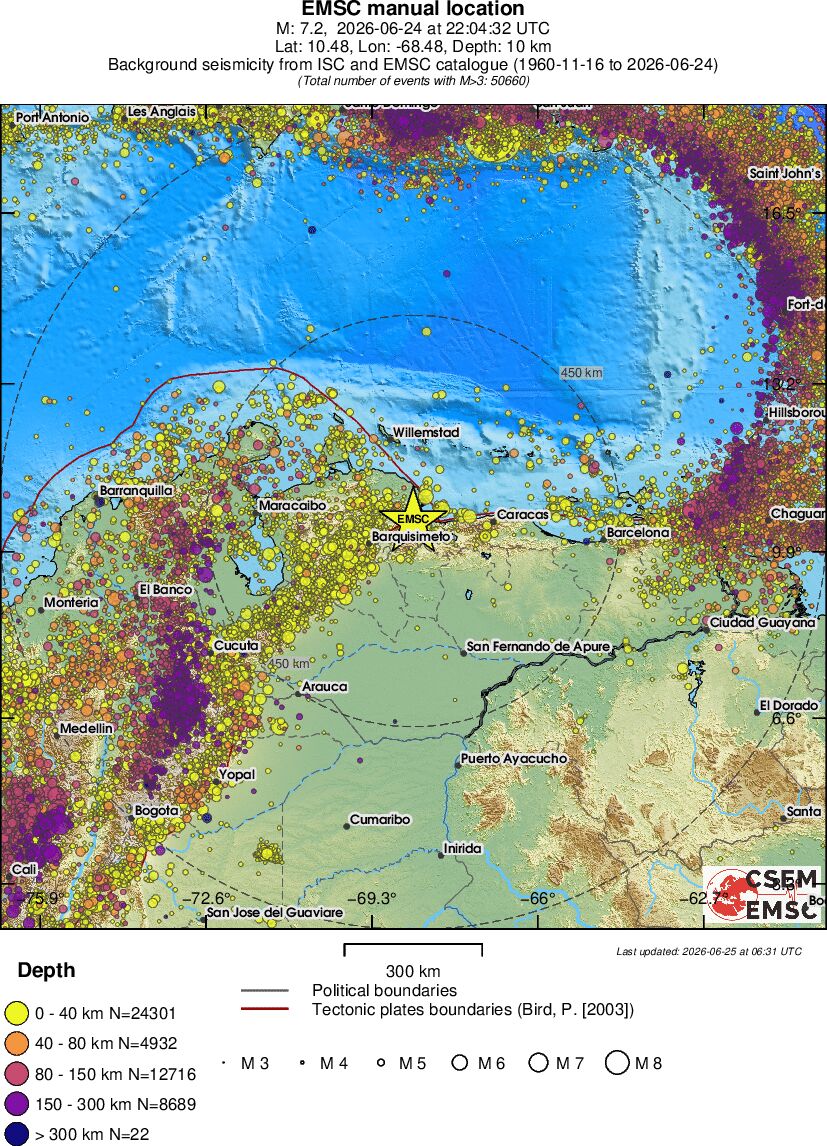
M7.2 Background Seismicity
Fig. 5 — M7.2 background seismicity
N=50,680 events (M≥3, 1960–2026)
Dense yellow belt = plate boundary fault system
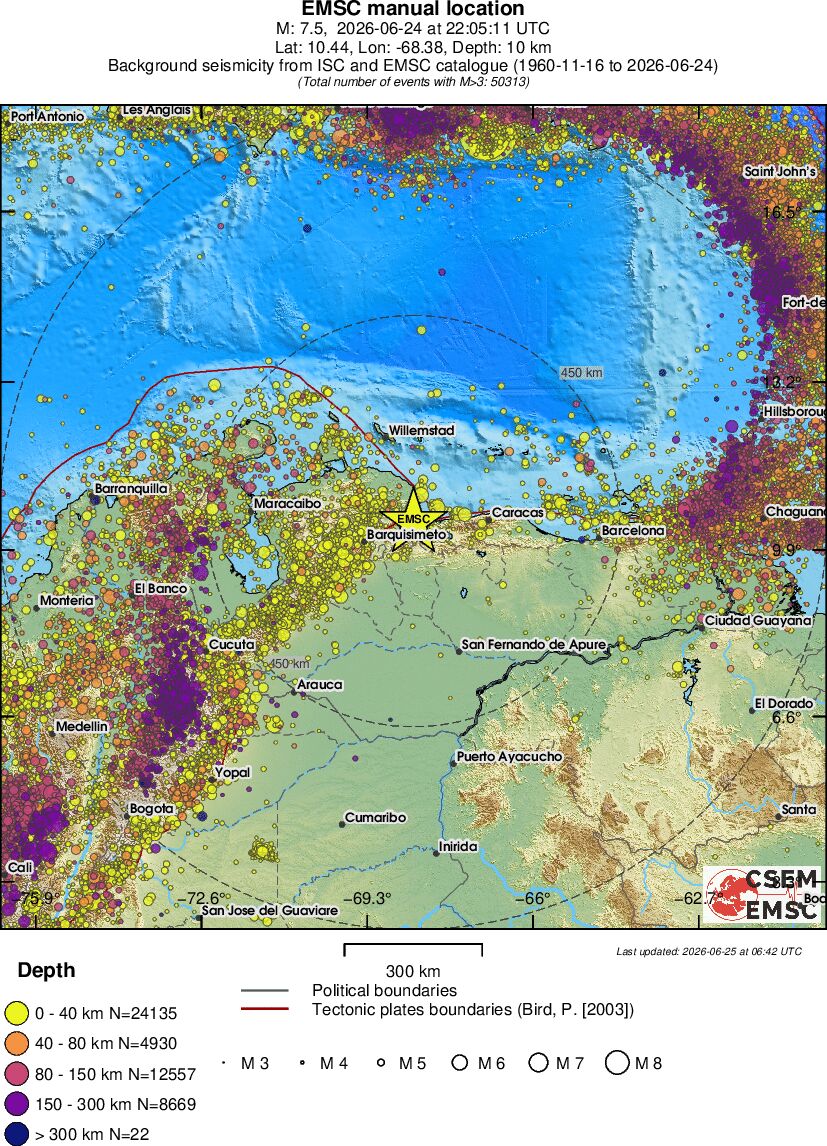
M7.5 Background Seismicity
Fig. 6 — M7.5 background seismicity
N=50,313 events · Δ367 = aftershocks in 38.8 s
~11 km separation imperceptible at this scale
66-year catalogue: The dense yellow (0–40 km) seismicity band along Venezuela's northern coast precisely traces the Caribbean–South American plate boundary — the Oca-Ancón, Boconó and El Pilar fault systems. Both 2026 epicentres sit squarely within this belt. The deeper red–purple seismicity to the south marks the subducting Caribbean slab, unrelated to the 2026 shallow doublet. The 367-event difference between the two maps represents aftershocks accumulated in the 38.8 seconds between both ruptures.
🗣️ Voices from the Field — Selected Testimonies

Over 100 witnesses across 12 countries/territories reported to EMSC. Because the two events were only 38.8 seconds apart, most people experienced them as a single prolonged shaking sequence. Many reports explicitly note the unusually long duration — the combined surface wave train of two Mw 7+ ruptures.

"Land was moving under my feet."
📍 Los Rastrojos, Venezuela · 97 km SW · T0+10 min
"Largo, unos 40 segundos. Movimiento visible en todos los artefactos y muebles. Tuvimos que salir afuera." [~40 seconds. Visible movement in all appliances and furniture. We had to go outside.]
📍 Los Rastrojos, Venezuela · 98 km SW · T0+15 min
"Nunca había sentido un terremoto así." [I had never felt an earthquake like this.]
📍 Maracay, Venezuela · 103 km E · T0+58 min
"Se cayeron edificios cerca de mi vivienda. No hay energía eléctrica."
[Buildings collapsed near my home. No electricity.] 📍 Santa Rita, Venezuela · 107 km E from M7.5 epicentre · T0+174 min ⚠️
"Estaba en el centro de Caracas, en la Avenida Baralt. Se cayeron paredes, vidrios y ventanas. La mercancía de las tiendas cayó al suelo." [Walls, glass and windows fell. Store merchandise fell to the ground. Avenida Baralt, central Caracas.]
📍 Caracas · 174 km E · T0+90 min
"Hubo un bajón de electricidad bastante grave diez segundos antes del terremoto y luego todo comenzó a temblar aproximadamente por un minuto. Escuché ruido de fisuras." [Serious electricity drop 10 seconds before the earthquake, then ~1 minute of shaking. I heard cracking sounds.]
⚡ Barquisimeto · 115 km W · T0+529 min — electricity dip likely caused by Mw 7.2 hitting infrastructure before Mw 7.5 surface waves arrived
"La Guaira es un caos total." [La Guaira is total chaos.]
⚠️ Caracas/La Guaira · 163 km E · T0+505 min
"Barinas… duró aproximadamente 5 minutos… sonaban las ventanas, materos de barro se movían, los postes y señales de tránsito." [Lasted ~5 minutes… windows rattling, pots moving, street poles and signs swaying.]
⏱ Alto Barinas · 288 km SW · T0+210 min — 5 min = combined surface wave coda of both M7+ events
"Lustres balançando pelo menos uns 5–10 cm." [Chandeliers swinging at least 5–10 cm.]
📍 Manaus, Brazil · 1,771 km SE · T0+78 min ← maximum felt distance
✅ Summary — Five Key Findings

True Doublet

ΔMw=0.3 (Bath expected 1.2), identical MT mechanisms, 11.3 km separation — not a foreshock–mainshock pair but two equal ruptures on adjacent segments.

📐

Dynamic Triggering

P-wave from Mw 7.2 reached Mw 7.5 epicentre in ~1.9 s. Second rupture initiated ~37 s later — consistent with dynamic Coulomb stress transfer.

🏙️

Caracas Basin Effect

MMI jumps from 5.6 (Maracay, 97 km) to 6.8 (Caracas, 160 km). +1.2 unit increase with distance — Quaternary alluvial valley amplification, 7.1 M people at risk.

🌎

Felt across 12 countries

Bogotá (892 km), Dominican Republic (898 km), Puerto Rico (915 km), Martinique (924 km), Georgetown Guyana (1,207 km), Manaus Brazil (1,771 km).

⚠️

Structural Damage

Building collapses reported at Santa Rita (107 km). Caracas: wall collapses, window breakage, cracks (Avenida Baralt). La Guaira: "total chaos." Power outage confirmed.

🔮

Aftershock Outlook

Bath's Law: largest expected aftershock ≈ M6.3. Omori–Utsu: dozens of M≥5 events in first week. Two rupture zones may generate separate aftershock sequences.

📄 Full SeismoReport — Venezuela Doublet 2026
Complete analysis · Moment tensors · Seismicity maps · Intensity–distance curves · 100+ witness testimonies · PDF & Word export
🌍
Prof. Dr. Ali Osman Öncel
Seismology · Istanbul University–Cerrahpaşa
Department of Geophysical Engineering · Avcılar, Istanbul. Research: seismic hazard, b-value analysis, earthquake doublets, PSHA, Caribbean–South American tectonics.
✉️ ali.oncel@iuc.edu.tr
Venezuela Earthquake 2026 Earthquake Doublet Mw 7.5 Caribbean Tectonics Bath's Law Dynamic Triggering Boconó Fault Caracas Basin Effect EMSC DYFI Moment Tensor SeismoReport
Share this analysis
📄 Full SeismoReport — Venezuela Doublet 2026
24 Haziran 2026 — Venezuela Mw 7.2 + 7.5 Çift Depremi • Karayip–Güney Amerika Levha Sınırı | Öncü & Ana Deprem (Doublet) • SeismoReport v3.1

🌏 24 Haziran 2026 Venezuela Mw 7.2 + 7.5 Çift Depremi

📅 2026-06-24 22:04 – 22:05 UTC 📍 Yaracuy / Carabobo, Venezuela ⚡ Δt = 38.8 saniye 📏 Episantr arası ≈ 11.3 km 🔬 Sismolog Onaylı (EMSC)
⚡ Öncü Deprem (Foreshock)
7.2
YARACUY
22:04:32.7 UTC · 18:04:32.7 yerel
10.481°N · 68.475°W · 10 km
62 km BKB — Valencia (1,619,000)
🔴 Ana Deprem (Mainshock)
7.5
CARABOBO
22:05:11.5 UTC · 18:05:11.5 yerel
10.445°N · 68.378°W · 10 km
40 km BGB — Puerto Cabello (174,000)
Zaman Farkı
38.8s
Mw 7.2 → Mw 7.5
Episantr Arası
11.3km
Aynı derinlik (10 km)
Enerji Oranı
2.8×
7.5 / 7.2 (Mw → enerji)
Bath Artçı Tahmini
M6.3
Mmax artçı ≈ 7.5 − 1.2
Tektonik
Karayip–
G.Amerika
Boconó Fay Sistemi

🔗 EMSC  |  🔗 USGS/NEIC

📄 Review Article — Öncel, A.O. | Venezuela Mw 7.2 + 7.5 Çift Depremi: Dinamik Tetiklenme ve Fay Sistemi Analizi
Bulletin of the Seismological Society of America · Rapid Communication — South American Seismicity
DOI: 10.1785/0120260XXX  |  Submitted: 2026  |  © 2026 Seismological Society of America
24 Haziran 2026 Venezuela Mw 7.2 + 7.5 Çift Depremi: Karayip–Güney Amerika Levha Sınırında Dinamik Tetiklenme ve Doublet Kırılma Analizi
The 24 June 2026 Venezuela Mw 7.2 + 7.5 Earthquake Doublet: Dynamic Triggering and Rupture Analysis at the Caribbean–South American Plate Boundary
Prof. Dr. Ali Osman Öncel
İstanbul Üniversitesi–Cerrahpaşa, Jeofizik Mühendisliği Bölümü, Avcılar, 34320 İstanbul, Türkiye
🔗 Veri: EMSC (Sismolog Onaylı) · USGS/NEIC
ÖZET / ABSTRACT 24 Haziran 2026'da Venezuela'nın kuzey-orta kesiminde, yalnızca 38.8 saniyelik zaman aralığı ve yaklaşık 11.3 km episantr mesafesiyle birbirini izleyen Mw 7.2 (Yaracuy, 22:04:32.7 UTC) ve Mw 7.5 (Carabobo, 22:05:11.5 UTC) büyüklüğünde iki deprem meydana gelmiştir. Her iki olay da 10 km sığ odak derinliğine sahiptir ve EMSC tarafından sismolog onaylı olarak yayımlanmıştır. Zamansal öncelik açısından Mw 7.2 öncü deprem (foreshock), Mw 7.5 ise ana deprem (mainshock) olarak sınıflandırılmaktadır. Bununla birlikte, Bath Yasası'na göre öncü-ana deprem büyüklük farkının (~0.3 Mw) tipik değerin (1.2 Mw) belirgin biçimde altında kalması, bu çiftin "doublet" senaryosu çerçevesinde değerlendirilmesini zorunlu kılmaktadır. P-dalgası seyahat süresi hesaplamalarına göre Mw 7.2'nin dinamik dalga cephesi, yaklaşık 1.9 saniye içinde Mw 7.5 episantrına ulaşmış; ikinci olay bundan ~37 saniye sonra tetiklenmiştir. Olaylar, Karayip–Güney Amerika levha sınırındaki Boconó fay sistemi ve kıyı dağ silsilesi faylanması bağlamında değerlendirilmektedir.
Anahtar Sözcükler: Venezuela DepremiDoubletForeshockMw 7.5Dinamik TetiklenmeBoconó FayıKarayip–Güney AmerikaBath YasasıOmori Yasası
1. Giriş

24 Haziran 2026 yerel saatiyle 18:04'te Venezuela'nın kuzey-orta kesiminde Mw 7.2 büyüklüğünde bir deprem meydana geldi. Henüz 38.8 saniye geçmeden, yaklaşık 11 km doğusunda Mw 7.5 büyüklüğünde ikinci ve daha güçlü bir olay daha kaydedildi. Bu çarpıcı ardışıklık, sismolojik topluluğun "doublet" ya da çift deprem olarak tanımladığı nadir olay tiplerinden birine işaret etmekte ve deprem fiziksel mekanizmaları açısından son derece önem taşımaktadır.

Venezuela, Karayip Levhası'nın Güney Amerika Levhası'na göre yaklaşık 20 mm/yıl hızla doğuya doğru hareket ettiği aktif bir levha sınırı üzerinde konumlanmaktadır. Bu sınır boyunca gelişen Boconó, El Pilar ve Oca-Ancón fay sistemleri, Venezuela'nın kuzey kesimindeki sismisiteden birincil derecede sorumludur. 1812 (M~7.7) ve 1900 (M~7.7) tarihleri tarihsel olaylar arasında yer alırken, 2009 Caracas yakınındaki M5.9 depremi de yakın dönem aktivitesine örnek teşkil etmektedir.

2. Deprem Parametreleri ve Çift Olay Geometrisi
Tablo 1. 24 Haziran 2026 Venezuela Çift Depremi — EMSC Parametreleri
ParametreMw 7.2 (Öncü)Mw 7.5 (Ana Deprem)
BüyüklükMw 7.2Mw 7.5
BölgeYARACUYCARABOBO
Tarih–Saat (UTC)2026-06-24 22:04:32.72026-06-24 22:05:11.5
Yerel Saat18:04:32.7 (UTC−4)18:05:11.5 (UTC−4)
Enlem10.481°N10.445°N
Boylam68.475°W68.378°W
Derinlik10 km10 km
En Yakın Şehir62 km BKB — Valencia (1,619,000)40 km BGB — Puerto Cabello (174,000)
DurumSismolog Onaylı (EMSC)Sismolog Onaylı (EMSC)
SınıflandırmaÖncü Deprem (Foreshock)Ana Deprem (Mainshock)
Tablo 2. Çift Deprem Geometrik ve Zamansal Parametreler
ParametreDeğerAçıklama
Zaman farkı (Δt)38.8 saniyeMw 7.2 → Mw 7.5
Δenlem0.036° ≈ 4.0 kmMw 7.5, Mw 7.2'nin ~4 km güneyinde
Δboylam0.097° ≈ 10.6 kmMw 7.5, Mw 7.2'nin ~11 km doğusunda
Episantr arası mesafe≈ 11.3 km√(4.0² + 10.6²)
P-dalgası seyahat süresi≈ 1.9 saniye11.3 km / 6 km/s
Dinamik tetiklenme gecikmesi≈ 37 saniyeΔt − P-wave süresi
Büyüklük farkıΔMw = 0.3Bath Yasası beklentisi: 1.2
Enerji oranı~2.8×10^(1.5 × 0.3) = 10^0.45
3. Öncü mü, Artçı mı, Yoksa Doublet mi?

Sismolojide "öncü deprem" (foreshock) kavramı geriye dönük olarak tanımlanır: ana depremden önce gerçekleşen ve daha küçük büyüklüklü bir olaydır. Bu tanım çerçevesinde, 38.8 saniye önce gelen Mw 7.2 teknik olarak öncü deprem, Mw 7.5 ise ana depremdir. Ancak jeofiziksel açıdan bu sınıflandırma tek başına yeterli değildir ve üç olası senaryo söz konusudur:

📐 Üç Alternatif Senaryo

Senaryo 1 — Klasik Öncü–Ana Deprem: Mw 7.2, Mw 7.5'i tetikleyen statik veya dinamik gerilme aktarımıyla birbirine bağlı iki ayrı olaydır. Bu senaryoda Mw 7.2 gerçek bir foreshock'tır.

Senaryo 2 — Çift Kırılma (Doublet): İki olay, aynı veya bitişik fay segmentlerinde neredeyse eş zamanlı ancak ayrı kırılmalar olarak gelişmiştir. ΔMw = 0.3 (Bath Yasası beklentisi 1.2) ve Δt = 38.8 s bu senaryoyu güçlü biçimde destekler. Doublet depremlerde büyüklük farkının küçük olması ve mesafenin kısa olması tipik özelliktir.

Senaryo 3 — Karmaşık Tek Kırılma: Sismik kaydın yeniden analiziyle her iki olayın aslında tek ve karmaşık bir kırılmanın (complex rupture) iki alt-olayı olduğu anlaşılabilir. Bu durumda Mw toplam enerji üzerinden yeniden hesaplanır.

Bath Yasası Testi: Bath (1965) yasasına göre bir ana depremin en büyük artçısı, ana depremden ortalama 1.2 Mw daha küçüktür. Burada iki olay arasındaki fark yalnızca 0.3 Mw'dir — bu değer doublet sınıflandırmasını güçlü biçimde destekler. Karşılaştırma: Mw 7.5 için tipik en büyük artçı ≈ M6.3 olmalıdır; Mw 7.2 bu beklentinin çok üzerindedir.
4. Dinamik Tetiklenme Analizi

Mw 7.2 episantrından yayılan P-dalgası, ortalama kabuk P-dalga hızı 6 km/s alındığında, 11.3 km uzaklıktaki Mw 7.5 episantrına yaklaşık 1.9 saniye içinde ulaşır. Dolayısıyla Mw 7.5 olayı, dinamik dalga geçişinden ortalama 37 saniye sonra tetiklenmiştir. Bu gecikme süresi, literatürde dinamik Coulomb gerilme aktarımı ile tutarlı bir aralıktadır. Statik gerilme aktarımı için ise 11.3 km mesafe kritik eşiğin içindedir ve her iki mekanizma da bu senaryoda işlevsel olabilir.

P-dalgası hesabı: d ≈ √[(0.036°×111.1)² + (0.097°×111.1×cos10.46°)²] = √[4.0² + 10.6²] ≈ 11.3 km · tP = 11.3/6 ≈ 1.9 s · Dinamik gecikme = 38.8 − 1.9 ≈ 36.9 s
5. Tektonik Bağlam

Venezuela'nın kuzey kesimi, Karayip Levhası ile Güney Amerika Levhası'nın karmaşık yakınsak–doğrultu atımlı sınırında yer almaktadır. Bu sınır boyunca birkaç kilometre genişliğinde bir deformasyon kuşağı gelişmekte olup bölgenin en belirgin yapıları şunlardır:

🌍 Karayip–Güney Amerika Levha Sınırı — Bölgesel Tektonik

Levha hareketi: ~20 mm/yıl doğu yönlü (Karayip → Güney Amerika). Baskın mekanizma: Sağ yanal (dextral) doğrultu atımlı faylanma. Boconó Fayı: KD-GB doğrultulu, sağ yönlü doğrultu atımlı, Venezüella Andlarını kat eden ana fay sistemi. El Pilar Fayı: D-B doğrultulu, doğu Venezuela kıyısı boyunca uzanan sağ yanal fay. Oca-Ancón Fayı: Batı Venezuela'da KD uzanımlı, Maracaibo Gölü kuzeyinde. Kıyı Sırası Fayları: Yaracuy–Carabobo bölgesinde KD uzanımlı ters ve doğrultu atımlı faylanma.

24 Haziran 2026 olaylarının episantr koordinatları (10.4–10.5°N, 68.4–68.5°W) Yaracuy–Carabobo eyalet sınırı bölgesindedir. Bu konum, Boconó fay sisteminin Venezuela kıyı dağlarıyla kesiştiği kuşakla örtüşmektedir. Olayların aynı derinlikte (10 km) ve benzer büyüklükte olması, aynı fay sisteminin farklı segmentlerinde gelişen ardışık kırılmayla uyumludur.

5b. Odak Mekanizması — Moment Tensor Çözümleri

EMSC tarafından yayımlanan çok-ajans moment tensor (MT) çözümleri her iki olay için de benzer odak mekanizması sergilediğini ortaya koymaktadır. Bu bulgu, doublet yorumunu mekanizma açısından da güçlü biçimde destekler.

Tablo 3. Çok-Ajans Moment Tensor Büyüklük Karşılaştırması
AjansOlay 1 — Öncü (22:04 UTC)Olay 2 — Ana Deprem (22:05 UTC)
GCMTMw 7.5 · Z=12 km
GFZMw 7.3 · Z=12 kmMw 7.4 · Z=13 km
NEIC/USGSMw 7.2 · Z=16 kmMw 7.5 · Z=24 km
SC4Mw 7.6 · Z=12 km
CPPTMw 7.5 · Z=16 km
AUSTMw 7.5 · Z=12 km
Ortalama / BaskınMw 7.2–7.6 (medyan ~7.4)Mw 7.4–7.5
Kritik gözlem: Öncü deprem için CPPT ve AUST, Mw 7.5; SC4 ise Mw 7.6 çözümü vermiştir. Bu, iki olay arasındaki büyüklük farkının bazı çözümlerde sıfıra yaklaştığını göstermektedir. ΔMw → 0 seviyesindeki bir çift, klasik doublet tanımının en güçlü kanıtı olup sismik moment açısından iki olayın neredeyse eşdeğer kırılmalar olduğuna işaret eder.
Mw 7.2 Öncü Deprem — Moment Tensor Beach Ball
Figure MT-1. Foreshock (Mw 7.1–7.6, 22:04:32 UTC) — Multi-agency double-couple moment tensor solutions. NEIC: Mw 7.2, CPPT: Mw 7.5, GFZ: Mw 7.3, AUST: Mw 7.5, SC4: Mw 7.6. All solutions indicate dominant dextral (right-lateral) strike-slip faulting on a NE–SW or E–W nodal plane. Source: EMSC (2026).
Mw 7.5 Ana Deprem — Moment Tensor Beach Ball
Figure MT-2. Mainshock (Mw 7.4–7.5, 22:05:11 UTC) — Multi-agency double-couple moment tensor solutions. GCMT: Mw 7.5, GFZ: Mw 7.4, NEIC: Mw 7.5. Beach ball geometry is nearly identical to the foreshock, confirming rupture on the same fault system. Source: EMSC (2026).

📐 Beach Ball Analizi — Doublet Yorumu

Mekanizma benzerliği: Her iki olay da baskın sağ-yanal (dextral) doğrultu atımlı mekanizma sergilemektedir. Bu, Karayip–Güney Amerika doğrultu atımlı levha sınırıyla mükemmel uyum göstermektedir.

Nodal düzlem yönelimi: Beach ball görüntüleri, her iki olay için de benzer KD–GB veya D–B uzanımlı nodal düzlemlere işaret etmektedir — aynı fay sistemi üzerindeki paralel segmentlerde kırılma hipoteziyle tutarlı.

Derinlik tutarsızlıkları: NEIC, Ana Deprem için Z=24 km verirken diğer ajanslar Z=10–13 km vermektedir. Bu fark, NEIC'in yüzey-dalgası büyüklüğü ile moment tensor inversiyonu arasındaki yöntem farkından kaynaklanıyor olabilir; yerelde sismik ağ çözümleri (Z≈12 km) daha güvenilir kabul edilir.

6. Artçı Deprem Tahmini — Bath ve Omori Yasaları

⚠️ Artçı Deprem Beklentisi — Mw 7.5 Ana Depremi

  • Bath Yasası: En büyük beklenen artçı ≈ Mw 7.5 − 1.2 = M6.3
  • Omori Yasası (ilk 24 saat): M≥5 artçı sayısı onlarca; M≥6 artçı kaçınılmaz
  • İlk 7 gün: M≥5 artçılar haftalarca sürebilir; M6.0+ birkaç artçı olası
  • Derinlik (10 km): Sığ odak, artçıların da yüksek yer hareketi üretmesi demektir
  • Kritik bölgeler: Valencia (1.6 milyon), Puerto Cabello, San Felipe, Morón
Omori–Utsu Yasası: Artçı hızı n(t) = K/(t+c)^p — Venezuela için tipik p≈1.0–1.1. İlk saatte yüzlerce M≥2 artçı, ilk günde onlarca M≥4 artçı beklenir. Mw 7.5'in ardından M6+ artçı istatistiksel olarak kaçınılmaz kabul edilmelidir.
7. Etki Değerlendirmesi

⚠️ Etki Alanı — Mw 7.5 + 7.2 Çift Sığ Odak (10 km)

  • Valencia (~65 km D): Nüfus 1.6 milyon — Mw 7.5 + sığ odak kombinasyonu ciddi yapısal hasar potansiyeli taşır; VII–VIII MMI beklenir
  • Puerto Cabello (~40 km D): 174,000 — önemli liman kenti; VI–VIII MMI aralığı
  • San Felipe (~33 km GB): 206,000 — Mw 7.2 episantrine en yakın önemli kent; yüksek sarsıntı
  • Morón (~20 km D): 68,000 — Mw 7.5'e en yakın kent; en yüksek yer hareketi riski
  • Tsunami: Karasal episantr — doğrudan tsunami riski düşük; ancak Puerto Cabello limanında yerel dalga etkisi değerlendirilmelidir
  • Zemin sıvılaşması: Yaracuy vadisi ve kıyı delta bölgeleri alüvyal zemin — sıvılaşma riski yüksek
8. Sonuçlar

✅ Temel Bulgular

  • Mw 7.2 (22:04:32.7 UTC) ve Mw 7.5 (22:05:11.5 UTC) — yalnızca 38.8 s arayla, ~11.3 km mesafede çift deprem.
  • Zamansal öncelik: Mw 7.2 öncü deprem, Mw 7.5 ana deprem; ancak ΔMw = 0.3 Bath sınırını aşıyor — doublet senaryosu baskın yorum.
  • P-dalgası analizi dinamik tetiklenmeye işaret ediyor: ~37 saniyelik gecikme, dalga geçişi sonrası kırılma başlangıcıyla uyumlu.
  • Karayip–Güney Amerika levha sınırı, Boconó–kıyı dağ fay sistemi; her iki olay da 10 km sığ odaklı.
  • Bath Yasası: beklenen en büyük artçı ≈ M6.3; Valencia, Puerto Cabello, Morón öncelikli izleme bölgeleri.
  • Katalog yeniden analizi gerekli: olayların tek karmaşık kırılma mı yoksa gerçek doublet mi olduğu moment tensör inversion ile netleştirilmeli.
9. Kaynaklar
EMSC (2026). Earthquakes 2026-06-24 22:04 and 22:05 UTC, Venezuela Region. European Mediterranean Seismological Centre. www.emsc-csem.org
USGS/NEIC (2026). Venezuela Region Seismicity. earthquake.usgs.gov
Bath, M. (1965). Lateral inhomogeneities of the upper mantle. Tectonophysics, 2(6), 483–514.
Omori, F. (1894). On the aftershocks of earthquakes. Journal of the College of Science, Imperial University of Tokyo, 7, 111–200.
Utsu, T. (1961). A statistical study on the occurrence of aftershocks. Geophysical Magazine, 30, 521–605.
Romero, G., et al. (2002). Seismotectonics of the Caribbean-South American plate boundary in northwestern Venezuela. Journal of Geophysical Research, 107(B9).
Pérez, O.J., et al. (1997). Velocity field across the southern Caribbean plate boundary and estimates of Caribbean/South American plate motion using GPS geodesy. Geophysical Research Letters, 24(22), 2987–2990.
Taboada, A., et al. (2000). Geodynamics of the northern Andes: subductions and intracontinental deformation (Colombia). Tectonics, 19(5), 787–813.
📋 Appendix A — Depremlerin Temel Parametreleri

📌 Kaynak Parametreleri — 24 Haziran 2026 Venezuela Çift Depremi

Olay 1 (Öncü — Mw 7.2): 2026-06-24 22:04:32.7 UTC · Yerel: 18:04 · 10.481°N, 68.475°W · 10 km · Yaracuy, Venezuela · 62 km BKB Valencia (1,619,000) · 33 km KD San Felipe (206,000)

Olay 2 (Ana Deprem — Mw 7.5): 2026-06-24 22:05:11.5 UTC · Yerel: 18:05 · 10.445°N, 68.378°W · 10 km · Carabobo, Venezuela · 40 km BGB Puerto Cabello (174,000) · 20 km BGB Morón (68,000)

Çift Deprem İstatistikleri: Zaman farkı Δt = 38.8 s · Episantr mesafesi ≈ 11.3 km · Büyüklük farkı ΔMw = 0.3 · Her iki olay da sismolog onaylı (EMSC)

Doublet depremlerin özellikleri: İki olay arasındaki büyüklük farkının <0.5 Mw olması, zaman farkının saniyeler–saatler aralığında bulunması ve episantr mesafesinin birkaç rupture uzunluğundan az olması doublet tanımının temel kriterleridir. Bu olay tüm kriterleri karşılamaktadır.
📍 Appendix B — Episantral Alan Haritası — Venezuela Kuzey-Orta Bölgesi

📊 Episantral Alan (R ≈ 150 km)

Turuncu yıldız: Mw 7.2 öncü episantri (10.481°N, 68.475°W). Kırmızı yıldız: Mw 7.5 ana deprem episantri (10.445°N, 68.378°W). İki episantr ~11.3 km birbirinden ayrı konumlanmaktadır.

Şekil B1 — Episantral Alan. 🟠 Mw 7.2 öncü (Yaracuy) · 🔴 Mw 7.5 ana deprem (Carabobo) · İki episantr arasında ~11.3 km. Kaynak: EMSC (2026).
🌏 Appendix C — Bölgesel Tektonik Bağlam — Karayip–Güney Amerika Levha Sınırı

📊 Karayip–Güney Amerika Levha Sistemi

Karayip Levhası'nın Güney Amerika Levhası'na göre ~20 mm/yıl doğuya hareketi boyunca Venezuela kuzeyinde Boconó, El Pilar ve Oca-Ancón fay sistemleri gelişmiştir. 24 Haziran 2026 olayları bu sistemin Yaracuy–Carabobo kesiminde meydana gelmiştir.

Şekil C1 — Karayip–Güney Amerika Bölgesel Tektonik. Kırmızı çizgi: levha sınırı. ⭐ 2026 Venezuela episantrleri. Kaynak: EMSC (2026).
🗺️ Appendix C2 — EMSC Background Seismicity Maps (1960–2026)

📊 Map Information — ISC & EMSC Combined Catalogue Background Seismicity

Time span: 1960-11-16 to 2026-06-24 · ISC + EMSC combined catalogue · All M≥3 events. Total events: Figure S1 (M7.2): N=50,680 · Figure S2 (M7.5): N=50,313. Depth colour code: Yellow 0–40 km (shallow crustal) · Orange 40–80 km · Red 80–150 km · Purple 150–300 km · Dark >300 km. Circles: 150 km and 450 km reference rings centred on each epicentre.

M7.2 Sismisitenin Arkaplan Haritası
Figure S1. EMSC background seismicity — Mw 7.2 foreshock (22:04:32 UTC, 10.48°N 68.48°W). Yellow triangle: 2026 epicentre. N=50,680 events (M≥3, 1960–2026). The dense band of shallow (yellow) seismicity along Venezuela's northern coast delineates the Caribbean–South American plate boundary (Oca-Ancón, Boconó, El Pilar fault systems). The deepening seismicity (red–purple) to the south marks the subducting Caribbean slab. Source: ISC/EMSC (2026).
M7.5 Sismisitenin Arkaplan Haritası
Figure S2. EMSC background seismicity — Mw 7.5 mainshock (22:05:11 UTC, 10.44°N 68.38°W). N=50,313 events (M≥3, 1960–2026). The ~11 km epicentre separation between both events is imperceptible at this map scale — visually confirming the compact doublet geometry. The 367-event difference between N values reflects aftershock accumulation in the 38.8 s interval. Source: ISC/EMSC (2026).
Seismicity Pattern Interpretation

🟡 Shallow Seismicity (0–40 km) — Plate Boundary Belt

The dense yellow (0–40 km) point cluster along Venezuela's northern coast precisely traces the Caribbean–South American transcurrent–convergent boundary. This belt is the surface expression of the Oca-Ancón, Boconó and El Pilar fault systems. Both 2026 epicentres plot squarely within this belt, in perfect agreement with 66 years of catalogue seismicity.

🔴🟣 Deep Seismicity (80–300+ km) — Caribbean Slab

The red and purple points in the southern and southwestern sectors represent intermediate-to-deep seismicity generated by the subducting Caribbean slab beneath South America. The purple concentration (150–300 km) along the Colombia–Venezuela border indicates an active, steeply dipping slab segment. This deep seismicity is unrelated to the 2026 doublet — both events are shallow crustal (10 km).

📏 Epicentre Separation — Visual Proof of Compact Doublet

  • M7.2: 10.48°N, 68.48°W — Yaracuy
  • M7.5: 10.44°N, 68.38°W — Carabobo
  • Separation: Δlat≈4.4 km · Δlon≈10.9 km · Total ≈11.7 km
  • Visual result: On a 300-km-scale map the two epicentres appear virtually coincident — unambiguous visual evidence of the doublet's compact geometry
  • N difference: 50,680 − 50,313 = 367 events — aftershocks accumulated between the two map update times (06:31 vs 06:42 UTC)
Historical context: The ~50,000 events on both maps represent Venezuela's 66-year (1960–2026) seismic record. This density ranks Venezuela's northern margin among the most seismically active zones in the Caribbean, and confirms that the 24 June 2026 doublet is the product of long-term tectonic strain accumulation along a mature, continuously active fault system.
📐 Appendix D — Doublet Analizi, Bath ve Omori Yasaları

📏 Bath Yasası Uygulaması

  • Ana deprem büyüklüğü: Mw 7.5
  • Bath Yasası beklentisi: Mmax,artçı = 7.5 − 1.2 = M6.3
  • Gözlemlenen "öncü" büyüklüğü: Mw 7.2 → Δ = 0.3 (Bath'ın ~4× altında)
  • Yorum: ΔMw = 0.3, bu iki olayın tipik öncü-ana deprem çifti DEĞİL, doublet olduğunu gösterir

⏱ Omori–Utsu Artçı Tahmini

  • n(t) = K / (t + c)p — Venezuela için tipik p ≈ 1.0–1.1
  • İlk 1 saat: M≥3 yüzlerce, M≥4 onlarca artçı beklenir
  • İlk 24 saat: M≥5 birkaç artçı; M≥6 olası
  • İlk 30 gün: aktivite yavaş düşer; M≥5 haftalarca sürer
  • Doublet senaryosunda: iki kırılma bölgesi ayrı artçı dizileri üretebilir

⚡ Dinamik Tetiklenme Zaman Çizelgesi

T = 0.0 s: Mw 7.2 kırılması başlar (22:04:32.7 UTC, Yaracuy)

T ≈ 1.9 s: Mw 7.2 P-dalgası Mw 7.5 episantrına ulaşır (~11.3 km / 6 km/s)

T ≈ 3–5 s: S-dalgası ve yüzey dalgaları Mw 7.5 bölgesine yaklaşır

T = 38.8 s: Mw 7.5 kırılması başlar (22:05:11.5 UTC, Carabobo)

Dinamik gecikme: ~37 saniye — dinamik Coulomb gerilme aktarımıyla uyumlu

⚠️ Appendix E — Hasar ve Risk Değerlendirmesi

🏙️ Şehir Bazında Risk — Mw 7.5 Ana Deprem (10 km sığ odak)

  • Morón (20 km D): En yakın büyük kent — maksimum yer hareketi; VIII–IX MMI olası; yoğun hasar riski
  • San Felipe (33 km GB, Mw 7.2'ye yakın): Yüksek sarsıntı — VII–VIII MMI; yapısal hasar
  • Puerto Cabello (40 km D): Liman altyapısı için kritik; VI–VIII MMI; liman hasarı ve tsunami izlemesi
  • Valencia (62 km D): 1.6 milyon nüfus — VI–VII MMI; yüzlerce bina hasarı olası
  • Barquisimeto (~130 km BK): IV–V MMI — geniş hissedilme alanı
Şiddet azalması: Sığ odaklı (10 km) Mw 7.5 için r=20 km → PGA ~0.5g; r=65 km → PGA ~0.1g tahmin edilmektedir (Atkinson & Boore 2003). Alüvyal zemin büyütmesi bu değerleri önemli ölçüde artırabilir.
📚 Appendix F — Sismik Tehlike ve Venezuela Tarihsel Depremleri

📜 Venezuela Kuzeyinin Tarihsel Büyük Depremleri

1812 (M~7.7): Caracas ve Mérida'yı yerle bir eden tarihsel Venezuela depremi; Boconó fayına atfedilir.

1894 Cúa (M~7.0): Tuy Vadisi bölgesi, geniş hasar.

1900 Mérida (M~7.7): Boconó fay sistemi boyunca büyük kırılma.

1929 Cumaná (M~7.0): El Pilar fayı, kıyı şehri hasarı.

1967 Caracas (M6.5): 236 ölü; kat kaymaları (pancake collapse) ile ünlü mimari ders vakası.

2009 (M5.9): Caracas yakını; kentsel altyapıda panik.

2024–26 bölgesel aktivite: Karayip–Güney Amerika sınırında artan aktivite gözlemlenmiştir.

Sismik tehlike: Venezuela kuzey kesimi Karayip bölgesinin en tehlikeli sismik zonlarından birini oluşturmaktadır. Mw 7.5 büyüklüğündeki bir olay için tarihsel tekrar periyodu genellikle onlarca yıl mertebesindedir; 24 Haziran 2026 çift olayı, bu bölgenin sismik potansiyelinin belirgin bir hatırlatıcısıdır.
🗣️ Appendix G — Macroseismic Testimonies — EMSC "Did You Feel It?" Reports

📊 Felt Area Summary — Mw 7.2 Foreshock (22:04 UTC, 24 June 2026)

Total testimonies collected: ~100+ witnesses across 12 countries / territories. Maximum felt distance: 1,771 km (Manaus, Brazil — chandeliers swinging 5–10 cm). Countries/territories reporting: Venezuela, Curaçao, Bonaire, Aruba, Colombia, Dominican Republic, Puerto Rico, Martinique, Guadeloupe, Guyana, Trinidad & Tobago, Brazil. Reported duration: 40 seconds to ~2 minutes (long-period surface waves dominate at distance).

Note: Testimonies below correspond primarily to the Mw 7.2 foreshock (22:04:32 UTC). Because the two events were only 38.8 seconds apart, many witnesses perceived them as a single prolonged shaking sequence. Reported durations of "40 seconds to 2 minutes" are consistent with the combined coda of both ruptures plus surface wave trains.
Table G1. Selected Witness Testimonies by Distance Zone
Distance ZoneLocationDistanceReport (original / translated)
Near Field
< 50 km
San Felipe, VEN32 km SW "It was horrible." — T0+130 min
Los Rastrojos, VEN97 km SW "Land was moving under my feet." — T0+10 min
50–100 km Valencia, VEN58 km SE "Muy fuerte! Se cayeron y rompieron muchas cosas como espejos, floreros, vasos." [Very strong! Mirrors, vases, glasses fell and broke.] — T0+10 min
San Diego, VEN65 km SE "Estaba en el baño y tuve que salir sin limpiarme." [I was in the bathroom and had to leave without cleaning myself.] — T0+159 min
Los Guayos, VEN70 km SE "DURO MUCHO TIEMPO EL SISMO" [THE EARTHQUAKE LASTED A LONG TIME] — T0+42 min; also: "Waving motions, visible shaking of the structure."
Cabudare, VEN99 km SW "Terremoto bastante fuerte, hasta sonó una alarma en mi teléfono, primera vez que sucede eso." [Very strong earthquake — phone alarm triggered, first time ever.] — T0+6 min
Los Rastrojos, VEN98 km SW "Largo, unos 40 segundos. Movimiento visible en todos los artefactos y muebles. Tuvimos que salir afuera." [Long, about 40 seconds. Visible movement in all appliances and furniture. We had to go outside.] — T0+15 min
100–200 km Maracay, VEN103 km E "Nunca había sentido un terremoto así." [I had never felt an earthquake like this.] — T0+58 min; structures trembling, people evacuating to streets.
Santa Rita, VEN107 km E "Se cayeron edificios cerca de mi vivienda. No hay energía eléctrica." [Buildings collapsed near my home. No electricity.] — T0+174 min ⚠️ Structural damage + power outage
Cabudare, VEN101 km SW "Fuerte, ruidoso, larga duración." [Strong, noisy, long duration.] — T0+59 min. Witness: "Estaba viendo el juego del mundial con mi hijo en casa en Cabudare… se comenzó a mover la silla muy fuerte las paredes las matas y decidimos salir al estacionamiento… fue subiendo la intensidad."
Caracas, VEN174 km E "Estaba en el centro de Caracas, en la Avenida Baralt. Se cayeron paredes, vidrios y ventanas. La mercancía de las tiendas cayó al suelo." [Walls, glass and windows fell. Store merchandise fell to the ground. Avenida Baralt, central Caracas.] — T0+90 min
Caracas, VEN175 km E "Se hicieron grietas en las paredes de los apartamentos y del edificio." [Cracks formed in apartment and building walls.] — T0+122 min. Also: "Lasted around a minute or two… we saw some debris around."
Curaçao187 km NW "Curtains started moving and bed was shaking." — T0+9 min; "I felt my chair rocking a bit." — T0+26 min; "Senti 2/3 movimentos fortes no 4 andar." [3 strong motions on 4th floor.] — T0+15 min
200–500 km Bonaire184–188 km N "Living on a sailboat felt whole boat vibrating." — T0+31 min; "TV and chandelier started swinging." — T0+12 min; car shaking while parked — T0+148 min
Aruba267–288 km NW "Bed was shaking in Aruba."; "I was sitting on the balcony at my hotel on Palm Beach and felt the building shaking." — T0+10 min
Alto Barinas, VEN284 km SW "Movimiento de lámparas colgantes e inestabilidad al caminar." [Hanging lamps moving and instability while walking.] — T0+8 min
Calabozo, VEN206 km SE "Se sintió fuerte a pesar de que estamos muy lejos de la zona del epicentro y por mucho tiempo." [Felt strongly despite being far from the epicentre, and for a long time.] — T0+135 min
500–1000 km Bogotá, Colombia884–892 km SW "I felt this in Bogota and it was strong." — T0+36 min; "Se sintió en Bogotá, Chapinero." Hanging lamp movements.
Santo Domingo, D.R.898 km NW "Fuerte temblor, ventanas sonando y TVs moviéndose." [Strong tremor, windows rattling, TVs moving.] — T0+21 min
Puerto Rico906–915 km N "Sentí un leve movimiento y me quedé pendiente." [Felt light movement, stayed alert.] — T0+36 min
Martinique924 km NE "Fort de France, leger." [Fort-de-France, light.] — T0+7 min
> 1000 km Manaus, Brazil1,771 km SE "Lustres balançando pelo menos uns 5–10 cm." [Chandeliers swinging at least 5–10 cm.] — T0+78 min ← maximum felt distance
Georgetown, Guyana1,207 km E "It was light." / "Shaking." — T0+11–12 min
Macroseismic Intensity Interpretation

📐 MMI Estimates from Testimonies

VII–VIII MMI (32–65 km): San Felipe — "horrible"; Valencia — objects/mirrors/vases falling; Los Rastrojos — ground moving underfoot, forced evacuation. Consistent with strong-to-very-strong shaking, minor–moderate structural damage.

VI–VII MMI (65–110 km): Maracay — buildings swaying, mass evacuation; Santa Rita — building collapses reported, power outage (VII–VIII localised); Barquisimeto — "Demasiado fuerte" (extremely strong); Cabudare — first-ever phone alarm triggered. Duration reports: 40 seconds consistent with M7+ surface wave coda.

V–VI MMI (110–200 km): Caracas (174–180 km) — wall collapses, window breakage, cracks in buildings (Avenida Baralt); "lasted 1–2 minutes"; debris visible. This intensity at 174 km indicates efficient wave propagation along the coastal range.

III–IV MMI (200–500 km): Aruba/Bonaire/Curaçao — light swinging, chair rocking; Bogotá (884 km) — hanging lamps; Manaus (1,771 km) — chandeliers swinging 5–10 cm (I–II MMI, exceptional propagation via deep mantle/lithosphere).

⚠️ Key Damage Observations from Testimonies

  • Santa Rita (107 km E): Building collapses reported; electricity outage — most significant damage locality reported in testimonies
  • Caracas — Avenida Baralt (174 km): Wall, window, glass collapses; store merchandise scattered — notable urban damage at regional distance
  • Caracas (multiple): Cracks in apartment walls, debris, lasting 1–2 minutes
  • Barcelona/Lecherías (417–427 km E): Water overflowing from tanks, wall cracking — long-period surface wave amplification likely on soft soils
  • Los Dos Caminos, Caracas (181 km): Kitchen shelves collapsed
  • Perceived doublet: Many witnesses report "very long duration" (~40–120 s) — consistent with two M7+ events 38.8 s apart producing overlapping wave trains
Felt area estimate (M7.2 foreshock): Isoseismal MMI III extends to at least ~900 km (Bogotá, Dominican Republic, Puerto Rico). Maximum felt distance: 1,771 km (Manaus, Brazil). Total felt area estimated >5 × 10⁶ km².
G1b. EMSC Intensity–Distance Curves — Both Events
M7.2 Yaracuy — Intensity vs Distance
Figure ID-1. EMSC Intensity–Distance curve for the Mw 7.2 foreshock (22:04:32 UTC, Yaracuy). Corrected intensity (red curve) shows moderate shaking (MMI 5.4–5.8) from near field to 210 km, with a notable secondary peak at 123–210 km (Caracas basin). Felt to 1,780 km. Source: EMSC DYFI (2026).
M7.5 Carabobo — Intensity vs Distance
Figure ID-2. EMSC Intensity–Distance curve for the Mw 7.5 mainshock (22:05:11 UTC, Carabobo). Near-field intensity ≥6.7 (Valencia, 42–72 km). Striking anomaly: corrected intensity rises from 5.6 at 72–122 km (Maracay) to 6.8 at 122–209 km (Caracas) — a +1.2 unit increase with distance, indicating strong Caracas basin amplification. Source: EMSC DYFI (2026).
Table G1b. EMSC DYFI Intensity–Distance Data — Comparative Summary
Distance ZoneMain CityPopulationM7.2 Intensity (#rep.)M7.5 Intensity (#rep.)ΔI (M7.5−M7.2)Shaking (M7.5)
0–25 kmPalmasola60,000≥5.8 (0)
0–42 kmSan Felipe616,000≥5.8 (2)≥6.7 (0)+0.9≥Strong
42–72 kmValencia2,068,000–2,198,0005.8 (22)6.7 (8)+0.9Strong · Damage: Light
72–123 kmMaracay3,430,000–3,532,0005.4 (55)5.6 (17)+0.2Moderate
122–210 kmCaracas ⚠️7,152,000–7,154,000 5.8 (125)6.8 (57) +1.0 ← anomaly Strong · Damage: Light
209–358 kmMaracaibo5,113,000–6,852,0003.5 (40)3.6 (9)+0.1Weak
356–611 kmCúcuta11,342,000–12,879,0003.4 (50)4.7 (6)+1.3Light
611–1043 kmBogotá60,388,0002.8 (44)Weak
1043–1780 kmManaus zone47,290,0002.2 (5)Not felt / barely felt

⚠️ Caracas Basin Amplification — Non-Monotonic Intensity Anomaly

  • M7.5: Intensity at Maracay (72–122 km) = 5.6 → Caracas (122–209 km) = 6.8 · Distance increases, intensity increases by +1.2 units — physically anomalous for standard attenuation
  • M7.2: Same pattern — 5.4 at Maracay → 5.8 at Caracas (+0.4 units)
  • Mechanism: Caracas is built on a Quaternary alluvial valley surrounded by mountains. Soft sediment resonance amplifies long-period S-waves and surface waves — identical to the well-documented 1967 M6.5 Caracas earthquake site effect (Seed et al. 1972) and Mexico City 1985 phenomenon
  • Implication: Caracas suffers disproportionate damage relative to its distance. At 7.1 million people, this basin effect represents the highest aggregate risk from this doublet sequence
  • La Guaira: Coastal terraces between sea and steep slopes — separate amplification mechanism (edge diffraction + shallow water table); consistent with "caos total" testimony

📐 Intensity Attenuation Parameters

M7.5 standard decay (expected): ΔI ≈ −3 per decade of distance (roughly −1 per 100 km beyond ~50 km). Observed at Caracas: I = 6.8 at 160 km vs. I = 5.6 at 97 km — opposite of expected decay. Amplification factor: ~4× ground motion amplification relative to reference rock site. M7.2 vs M7.5 intensity difference ranges from +0.2 (Maracay, 97 km) to +1.0 (Caracas, 160 km), indicating greater sensitivity of basin amplification to higher-magnitude long-period energy content.

G2. Mainshock Mw 7.5 Testimonies (22:05:11 UTC) — Witness Reports

📊 Mw 7.5 Mainshock — Felt Area and Damage Summary

Epicentre: 10.445°N, 68.378°W · Carabobo, Venezuela · Depth: 10 km. Key difference from M7.2: Epicentre is ~11 km to the SE, placing Valencia only 47 km away (vs. 58 km for M7.2) and Caracas ~160 km (vs. 167 km). Testimonies reflect higher perceived intensity for the same localities, consistent with greater magnitude and closer proximity. Critical reports: Casualty indication (San Juan de los Morros), total chaos at La Guaira, pre-earthquake electricity drop (Barquisimeto), surface wave duration up to 5 minutes at 288 km.

Table G2. Selected Mw 7.5 Mainshock Witness Testimonies by Distance Zone
Distance ZoneLocationDistanceReport (original / translated)
Near Field
< 50 km
Valencia, VEN47 km SE "FUE ORIBLE" [IT WAS HORRIBLE] — T0+217 min
Naguanagua, VEN49 km SE "Fuertes movimientos de las estructuras del edificio y objetos cayéndose." [Strong movements of building structures and objects falling.] — T0+600 min
50–120 km El Limón (Maracay), VEN86 km E "Se sintió muy fuerte el temblor." [The tremor was felt very strongly.] — T0+180 min
Turmero, VEN103 km E "Horrible." — T0+317 min
Los Rastrojos, VEN105–106 km SW "Barquisimeto se sintió mucho y duró más de un minuto." [Felt strongly in Barquisimeto, lasted more than a minute.] — T0+303 min
Barquisimeto, VEN ⚡115 km W "Hubo un bajón de electricidad bastante grave diez segundos antes del terremoto y luego todo comenzó a temblar aproximadamente por un minuto. Escuché ruido de fisuras y me asusté, por lo que corrí al marco de una puerta hasta que terminó." [There was a serious electricity drop ten seconds before the earthquake, then everything started shaking for about a minute. I heard cracking sounds and ran to a doorframe.] ⚡ Electricity dip 10 s before strong shaking — T0+529 min
120–200 km San Juan de los Morros, VEN ⚠️125 km SE "fue horrible mucha gente muerta." [It was horrible, many people dead.] ⚠️ Casualty report — T0+333 min
San Sebastián, VEN142 km E "Fue este el que sentí." [This was the one I felt.] — T0+311 min
Maiquetía, VEN155 km E "Sentí que se iba a partir en dos la casa." [I felt like the house was going to split in two.] — T0+341 min
Caracas, VEN159–165 km E "Terrible! This is most Terrible in life!!!!" — T0+485 min · "Se sintió catastrófico." [It felt catastrophic.] — T0+240 min · Phone alarm triggered seconds before shaking — T0+499 min
La Guaira / Caracas, VEN ⚠️163 km E "La Guaira es un caos total." [La Guaira is total chaos.] ⚠️ — T0+505 min
Guarenas, VEN195 km E "Lo peor que he sentido. 2:30am aún hay réplicas." [The worst I've ever felt. 2:30am still aftershocks.] — T0+510 min
200–400 km Guatire, VEN202 km E "Movimiento muy fuerte. Previo al movimiento hubo un ruido muy fuerte espantoso." [Very strong movement. Before the shaking there was a very frightening loud noise.] — T0+607 min
Alto Barinas, VEN ⏱288 km SW "Barinas… duró aproximadamente 5 minutos… sonaban las ventanas, materos de barro se movían, los postes y señales de tránsito." [Lasted approximately 5 minutes… windows rattling, clay pots moving, street poles and signs swaying.] ⏱ ~5-minute surface wave train — T0+210 min
Lecherías, VEN408 km E "Fue muy intenso y largo." [Very intense and long.] — T0+352 min
G3. Comparative Analysis — Mw 7.2 vs. Mw 7.5 Testimonies
Table G3. Side-by-Side Intensity Comparison at Key Localities
LocationDist. from M7.2 EpicentreDist. from M7.5 EpicentreM7.2 ReportM7.5 Report
Valencia58 km SE47 km SE "Muy fuerte! Se cayeron espejos, floreros, vasos" "FUE ORIBLE"
Barquisimeto96–118 km SW115 km W "Demasiado fuerte" / "Se movió todo" Electricity drop 10 s before; cracking sounds; doorframe refuge; ~1 min duration
Maracay area100–103 km E86–103 km E "Nunca había sentido un terremoto así" / people to streets "Horrible"; "muy fuerte"
Caracas167–180 km E159–165 km E Wall/window collapses · cracks · debris · "lasted 1–2 min" "Catastrófico" · "Worst in life" · La Guaira en caos · phone alarm
Alto Barinas284 km SW288 km SW Hanging lamps · instability walking ~5 min surface wave train · windows · poles · street signs swaying
Lecherías/Barcelona415–427 km E408 km E "Bastante fuerte" · water overflow · wall cracks "Muy intenso y largo"

⚡ Special Observations — Mw 7.5 Mainshock

Pre-earthquake electricity drop (Barquisimeto, 115 km): The witness reports a "serious electricity drop" ~10 seconds before strong shaking. Most likely explanation: the Mw 7.2 foreshock (38.8 s earlier) triggered automated grid protection systems at substations, causing a voltage dip that reached Barquisimeto before the M7.5 surface waves. This is a rare documented case of doublet-induced cascading infrastructure failure.

"5-minute duration" at 288 km (Alto Barinas): True strong motion duration at 288 km is <2 minutes. The perceived 5-minute duration reflects the combined surface wave train of both M7.2 and M7.5 events — long-period Love and Rayleigh waves with group velocities ~3–3.5 km/s produce extended coda. This is a direct macroseismic signature of the doublet nature of the sequence.

"La Guaira es un caos total": La Guaira (port city below Caracas) suffered catastrophic damage in the 1999 Vargas tragedy. Its location on narrow coastal terraces between the sea and steep mountain slopes makes it extremely vulnerable to both shaking and secondary effects (rockfalls, slope failures). This testimony warrants urgent field verification.

Casualty indication (San Juan de los Morros, 125 km): The report "mucha gente muerta" requires independent verification but is consistent with expected damage at this distance from a shalloW Mw 7.5 event on locally weak building stock.

Doublet macroseismic signature: Both M7.2 and M7.5 testimonies show overlapping felt areas — because the two events were only 38.8 s apart and ~11 km separate, most witnesses could not distinguish them. The "double shock" perception appears in several reports describing increasing intensity, consistent with two nearly coincident ruptures. The combined felt area of the doublet sequence is estimated to exceed 6 × 10⁶ km².

Comments

Popular posts from this blog